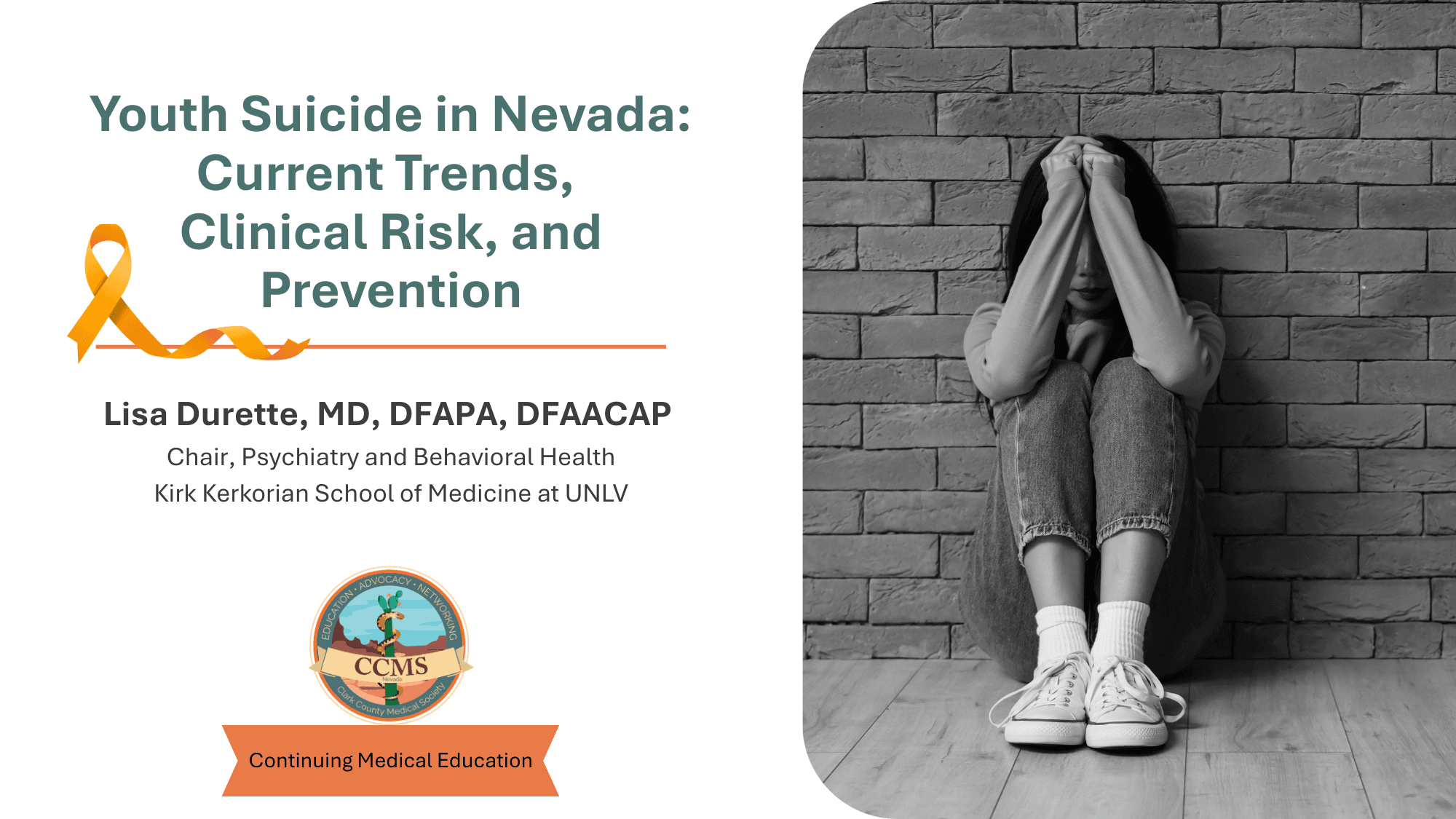
Youth Suicide in Nevada: Current Trends, Clinical Risk, and Prevention
0% Complete
Course Overview
This presentation examines current trends in youth suicide in Nevada, with a focus on suicide-related data, clinical risk factors, warning signs, and prevention strategies. It reviews recent Nevada Youth Risk Behavior Survey findings, including trends in suicidal thoughts and behaviors among high school students, as well as disparities related to sexual orientation and gender identity. The presentation also addresses factors associated with increased suicide risk, including mental health and acute clinical changes, bullying and digital experiences, substance use, trauma, and cumulative adversity.
Participants will explore the concept that suicide risk is multifactorial and that no single risk factor determines an individual's level of risk. The presentation introduces a layered approach to suicide prevention, including universal, selective, and indicated strategies, and provides a practical clinical pathway for screening, assessment, intervention, follow-up, and lethal-means counseling. Evidence-based resources and screening approaches, including the Ask Suicide-Screening Questions (ASQ), are discussed to support clinicians in identifying and responding to youth who may be experiencing suicidal thoughts or behaviors.
Course Content
Credits
* AMA PRA Category 1™ credits are used by physicians and other groups like PAs and certain nurses. Category 1 credits are accepted by the ACCME, ARDMS, CCI, and Sonography Canada.
Course Details
- Duration
- 0.50 hour
- Released
- Sep 17, 2026
- Last Review
- Sep 17, 2026
- Expires
- Sep 16, 2029
Objectives
Review the newest Nevada youth suicide and self-harm data
Compare3 Nevada 2025 YRBS findings with the latest national YRBS data
Recognize disparities, risk factors, and protective factors relevant to clinical care
Apply a practical screening, assessment, and safety planning workflow in medical settings
Target Audience
This presentation is intended for healthcare professionals who provide care to children and adolescents, including pediatricians, family medicine physicians, psychiatrists, psychologists, social workers, nurses, physician assistants, and other clinicians involved in the assessment, treatment, and prevention of suicide among youth. It may also be relevant to healthcare professionals working in emergency, behavioral health, primary care, and school-based clinical settings.
Faculty & Disclosure
Faculty
Lisa Durette, MD
Disclosure
Financial Disclosures
Neither the speaker nor any of the planners for this educational activity have relevant financial relationships to disclose with ineligible companies whose primary business is producing, marketing, selling, re-selling, or distributing products used by or on patients.
All of the relevant financial relationships listed for these individuals have been mitigated. Remaining persons in control of content have no relevant financial relationships.
This activity was developed without any financial support, influence, or involvement from any ineligible companies.
Accreditation and Credit Designation
The Clark County Medical Society is accredited by the Utah Medial Association (UMA) to provide continuing medical education for physicians.
The Clark County Medical Society designates this live educational activity for a maximum of 0.5 AMA PRA Category 1 CreditsTM. Physicians should claim only the credit commensurate with the extent of their participation in the activity.
Accreditation
The Clark County Medical Society is accredited by the Utah Medical Association (UMA) to provide continuing medical education for physicians.
The Clark County Medical Society designates this live educational activity for a maximum of 0.50 AMA PRA Category 1 Credits™. Physicians should claim only the credit commensurate with the extent of their participation in the activity.