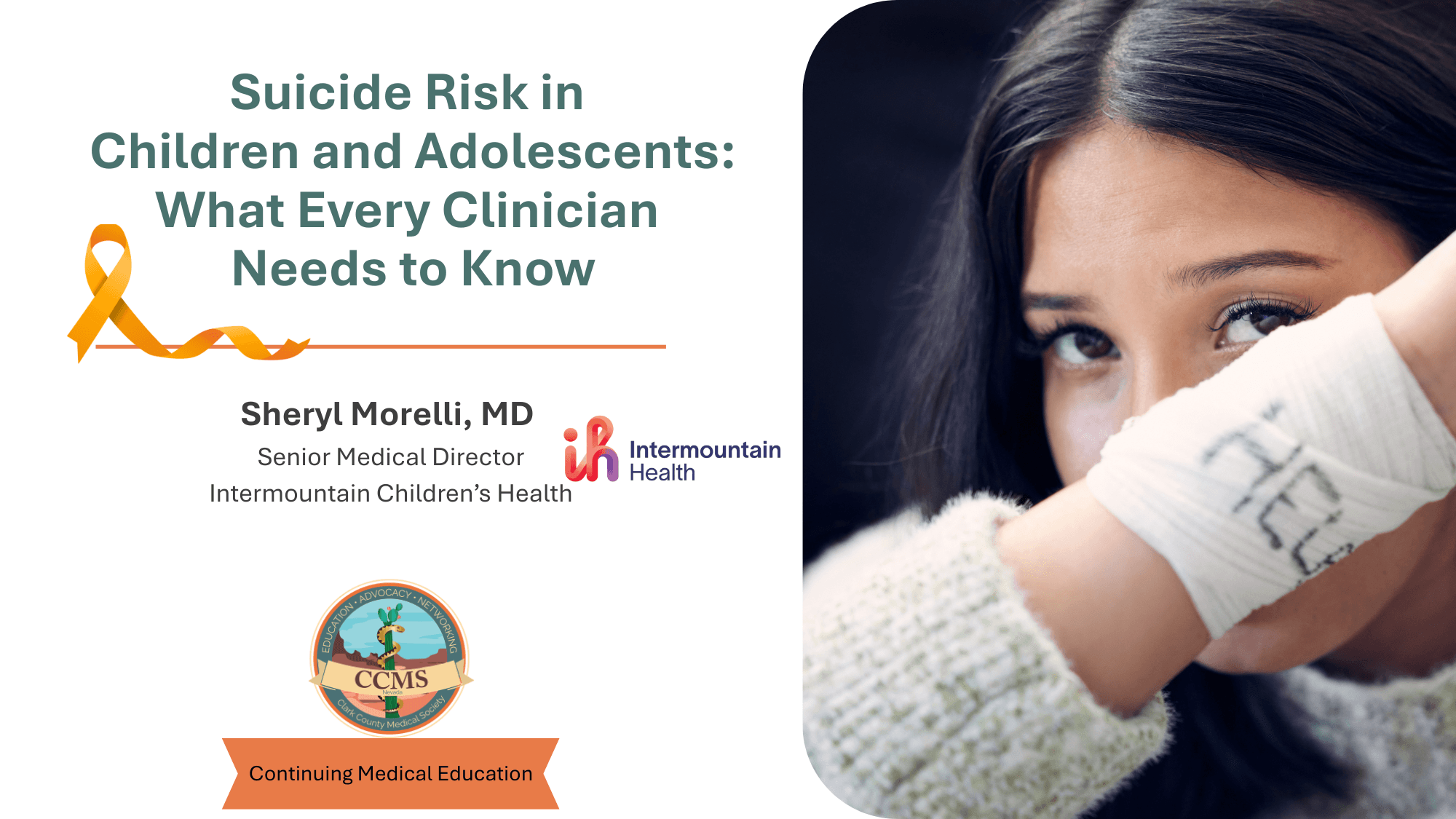
Suicide Risk in Children and Adolescents: What Every Clinician Needs to Know
0% Complete
Course Overview
Youth suicide continues to be a growing public health crisis, with healthcare professionals uniquely positioned to identify at-risk children and adolescents before a suicide attempt occurs. This enduring educational activity equips clinicians with practical, evidence-based strategies for recognizing suicide risk, implementing validated screening tools, conducting appropriate risk assessments, and engaging patients and families using trauma-informed communication. Participants will review current epidemiologic trends, developmental considerations, risk and protective factors, and evidence-based approaches to intervention, safety planning, and referral. Emphasis is placed on the critical role of healthcare providers across all clinical settings in improving early identification and preventing youth suicide.
Course Content
Credits
* AMA PRA Category 1™ credits are used by physicians and other groups like PAs and certain nurses. Category 1 credits are accepted by the ACCME, ARDMS, CCI, and Sonography Canada.
Course Details
- Duration
- 0.75 hour
- Released
- Jul 14, 2026
- Last Review
- Jul 14, 2026
- Expires
- Jul 14, 2029
Objectives
Upon completion of this activity, participants should be able to:
Review current epidemiologic trends and developmental factors contributing to suicide risk among children and adolescents.
Recognize key risk factors, protective factors, and warning signs of suicidal ideation across pediatric developmental stages.
Implement evidence-based suicide risk screening using validated assessment tools in clinical practice.
Differentiate between suicide screening, brief suicide safety assessments, and indications for urgent behavioral health intervention.
Develop patient-centered safety plans that incorporate family engagement, lethal means counseling, and appropriate community resources.
Apply trauma-informed communication strategies when discussing suicide risk with pediatric patients and their families.
Identify local and national mental health resources to facilitate timely referral, treatment, and ongoing support for youth at risk of suicide.
Target Audience
This activity is designed for physicians, physician assistants, nurse practitioners, nurses, psychologists, social workers, counselors, pharmacists, and other healthcare professionals who provide care to children and adolescents in primary care, emergency medicine, pediatrics, family medicine, behavioral health, school-based health, urgent care, and specialty care settings. It is also appropriate for healthcare professionals seeking to strengthen their knowledge of evidence-based suicide risk screening, assessment, intervention, and referral to improve outcomes for youth at risk of suicide.
Faculty & Disclosure
Faculty
Financial Disclosures
None of the speakers, planners, or moderators for this educational activity have relevant financial relationships to disclose with ineligible companies whose primary business is producing, marketing, selling, re-selling, or distributing products used by or on patients.
All of the relevant financial relationships listed for these individuals have been mitigated. Remaining persons in control of content have no relevant financial relationships.
This activity was developed without any financial support, influence, or involvement from any ineligible companies.
Mitigation of Relevant Financial Relationships
All of the relevant financial relationships listed for these individuals have been mitigated. Remaining persons in control of content have no relevant financial relationships.
Disclosure
Sheryl Morelli, MD discloses no such relationships exist
Accreditation
The Clark County Medical Society is accredited by the Utah Medical Association (UMA) to provide continuing medical education for physicians.
The Clark County Medical Society designates this live educational activity for a maximum of 0.75 AMA PRA Category 1 Credits™. Physicians should claim only the credit commensurate with the extent of their participation in the activity.